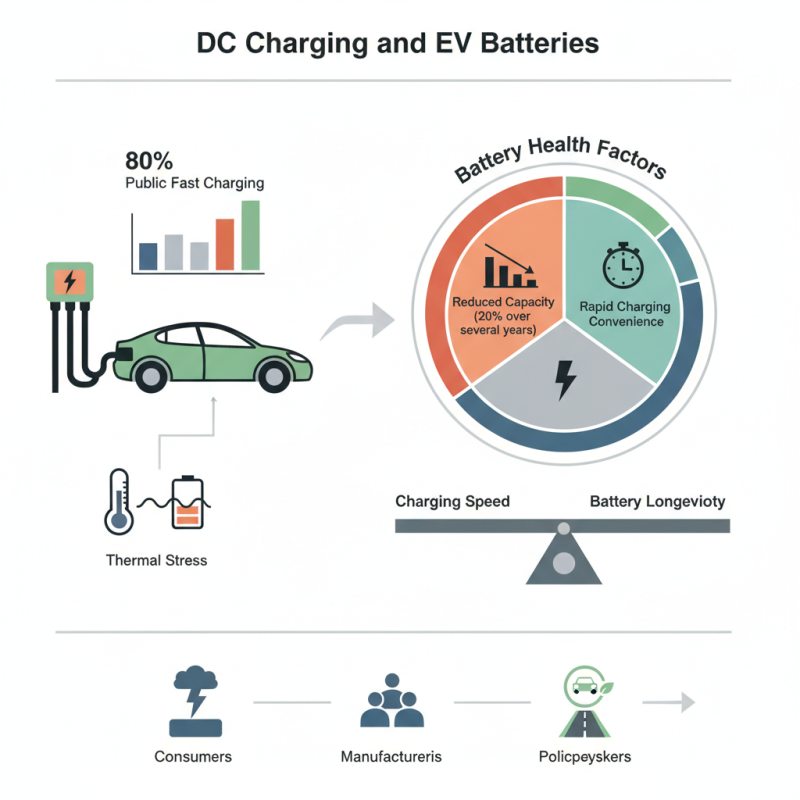
The impact of DC chargers on electric vehicle (EV) battery life and performance is a pressing concern for manufacturers and consumers alike. According to a recent study by the International Energy Agency, over 80% of EV users rely on public fast charging stations, primarily DC chargers. This widespread usage underscores the importance of understanding how DC chargers impact EV battery life.
Dr. Emily Carson, a leading authority in battery technology, emphasizes, "Fast charging can lead to thermal stress, affecting the longevity of lithium-ion batteries." This statement highlights the need to balance charging speed and battery health. DC fast chargers deliver higher voltage and current, which can accelerate charging times, but they may also introduce long-term risks to battery performance.
Research indicates that frequent use of DC chargers may reduce overall battery capacity by 20% over several years, raising questions about sustainability. However, the convenience of rapid charging cannot be ignored. As the EV market grows, striking a balance between charging efficiency and battery health is crucial for the future of electric mobility. Understanding how DC chargers impact EV battery life can provide valuable insights for consumers, manufacturers, and policymakers.
DC fast chargers have become essential in the electric vehicle (EV) landscape. However, their impact on battery life varies significantly. A study by the International Council on Clean Transportation (ICCT) shows that frequent use of DC chargers can lead to a decrease in battery capacity over time, revealing a complex relationship between charging speed and battery health.
Charging at high voltages can stress the battery cells. The rapid influx of electricity generates heat, which can accelerate degradation. Research indicates that ultra-fast charging can reduce a battery's lifespan by as much as 20%. While DC fast chargers provide convenience, they might not always be the best choice for long-term battery health.
It's crucial to balance the need for quick charging with care for the battery's longevity. Some EV owners may charge quickly when in a hurry, but this can hinder the overall efficiency of the battery. Regularly using standard AC chargers may extend the battery's life. Ultimately, achieving optimal battery performance requires mindful charging habits and occasional reflection on charging choices.
The chemistry of an EV battery plays a crucial role in its performance and longevity. Lithium-ion batteries, the most common in electric vehicles, operate through complex chemical reactions. These reactions involve lithium ions moving between the anode and cathode. Charging dynamics greatly influence these processes. Rapid charging, while convenient, can lead to increased temperatures. High temperatures can accelerate battery degradation over time.
DC fast chargers provide a quick boost but may stress the battery. Frequent use of fast chargers can cause heat buildup, impacting the battery's cycle life. It’s essential to consider the charging environment as well. Cool temperatures can help mitigate some of the heat generated. Balancing convenience and battery health is key for EV owners.
Understanding battery management systems adds another layer of complexity. These systems help monitor temperature and charge levels, aiming to optimize performance. However, software can sometimes misjudge battery needs. This leads to premature battery aging and reduced efficiency. EV users must remain informed about best charging practices to sustain battery health over time.
This chart illustrates the impact of fast DC charging on electric vehicle battery metrics. The data shows that with the use of DC chargers, an electric vehicle battery may have an average lifespan of approximately 7 years, maintain about 80% capacity retention over its life, and can typically be charged in about 1.5 hours.
DC fast charging provides rapid power to electric vehicles (EVs), but has varied impacts on
battery life and performance. This method delivers high currents that can cause
excess heat during charging. Heat is detrimental to battery health in the long term.
It can lead to faster degradation, reducing the overall lifespan of the battery. Conversely,
Level 2 charging offers a slower, gentler approach. It delivers power
more steadily, resulting in less thermal strain on the battery.
Efficiency is another point of comparison. DC fast charging can fill a battery to
80% in 30 minutes. This is appealing for short stops. Yet, frequent use
without consideration of thermal management can lead to capacity loss. Level 2 chargers, while slower, promote a healthier charging cycle.
They often maintain the battery’s state of health better over time. However, some users may find Level 2 charging inconvenient
due to longer wait times.
Choosing between these charging methods is not straightforward. Drivers must consider their
daily routines. Fast chargers can expand travel ranges quickly, but
longevity might suffer. There are trade-offs. Finding a balance depends
on individual needs and habits. Each charging method has its merits and drawbacks, requiring
careful consideration.
DC charging can significantly impact the life and performance of electric vehicle (EV) batteries. High charging speeds lead to increased heat, which accelerates battery degradation. A 2020 study by the International Council on Clean Transportation revealed that fast charging could shorten battery lifespan by up to 30%. This is due to the stress placed on battery components, especially during rapid charge cycles.
Another crucial factor is the state of charge (SoC) when using DC chargers. Research indicates that frequently charging between 80% and 100% can strain batteries more than keeping them at a lower SoC. Maintaining a consistent charge level below 80% is often recommended for enhancing longevity. Additionally, temperature plays a critical role; extreme heat or cold can negatively affect charging efficiency and battery life. Most manufacturers suggest optimal charging temperatures between 20°C to 25°C (68°F to 77°F).
Moreover, the type of DC charger used can further complicate the situation. Not all chargers are equal; variations in current output and voltage can lead to uneven charging rates. Standardization across charging stations is still a work in progress, which can create challenges for users. Continuous progress in battery technology is essential, as current systems may not withstand the continuous demands placed by rapid charging without degradation.
| Factor | Impact on Battery Life | Impact on Performance | Recommended Practices |
|---|---|---|---|
| Charging Speed | Accelerates degradation if excessively high | Can provide quick charge but may lead to thermal issues | Limit charging to recommended levels |
| Charging Temperature | High temperatures can hurt battery chemistry | Performance may drop in extreme temperatures | Charge in moderate temperature ranges |
| State of Charge (SoC) | Frequent charging between 20% and 80% is ideal | Can improve overall battery health and responsiveness | Avoid discharging below 20% regularly |
| Cycle Frequency | Higher cycles lead to accelerated wear | May reduce charging efficiency over time | Minimize unnecessary charging sessions |
Using DC chargers for electric vehicles (EVs) can significantly impact battery life and performance. To maximize battery health, understanding charging practices is crucial. Research indicates that DC fast charging, while convenient, can lead to increased thermal stress on the battery. A report from the International Council on Clean Transportation highlights that frequent fast charging may reduce battery capacity by up to 30% over time.
To preserve battery longevity, consider the state of charge (SoC). Maintaining a SoC between 20% and 80% can mitigate stress. Studies show that charging within this range helps avoid excessive heat buildup. Implementing this practice can help maximize lifespan while still utilizing fast charging when necessary.
Another aspect involves charging frequency. Limiting DC fast charging to essential trips can be beneficial. A study by the National Renewable Energy Laboratory suggests that relying predominantly on Level 2 AC charging at home can enhance battery health significantly. Additionally, incorporating battery management systems can help monitor temperature and charge levels, preventing potential degradation. While DC charging offers speed, balancing it with careful usage is essential for optimal battery care.
: DC fast chargers can decrease battery capacity over time due to high charging speeds.
Heat generated from rapid charging stresses battery cells and accelerates degradation.
Yes, frequent use may reduce battery lifespan by up to 20% or more.
Using standard AC chargers regularly and maintaining a charge below 80% can help.
Battery chemistry influences how lithium ions move, affecting overall performance and longevity.
Extreme temperatures can negatively impact charging efficiency and battery life.
They may misjudge battery needs, leading to premature aging and reduced efficiency.
No, variations in current output can lead to uneven charging and complicate usage.
Most manufacturers recommend charging temperatures between 20°C to 25°C (68°F to 77°F).
Regular evaluation of charging choices can promote better battery health and performance.
The article "How Do DC Chargers Affect EV Battery Life and Performance?" explores the implications of using DC fast chargers on the longevity and efficiency of electric vehicle (EV) batteries. It highlights the chemistry of EV batteries and the dynamics of charging, emphasizing that while DC fast charging offers rapid replenishment of energy, it may lead to increased battery degradation compared to Level 2 charging techniques.
Additionally, the article discusses various factors that contribute to battery wear when utilizing DC chargers, such as charging frequency and temperature. To mitigate potential adverse effects and maximize battery health, it provides best practices for EV owners, including optimal charging habits and maintenance tips. Overall, understanding how DC chargers impact EV battery life is crucial for extending battery performance and enhancing overall vehicle longevity.

Vernon Charger